Revealing the Idea Behind the Painting "Fortune Teller"
· 4 min read
The Painting's Intent Revealed
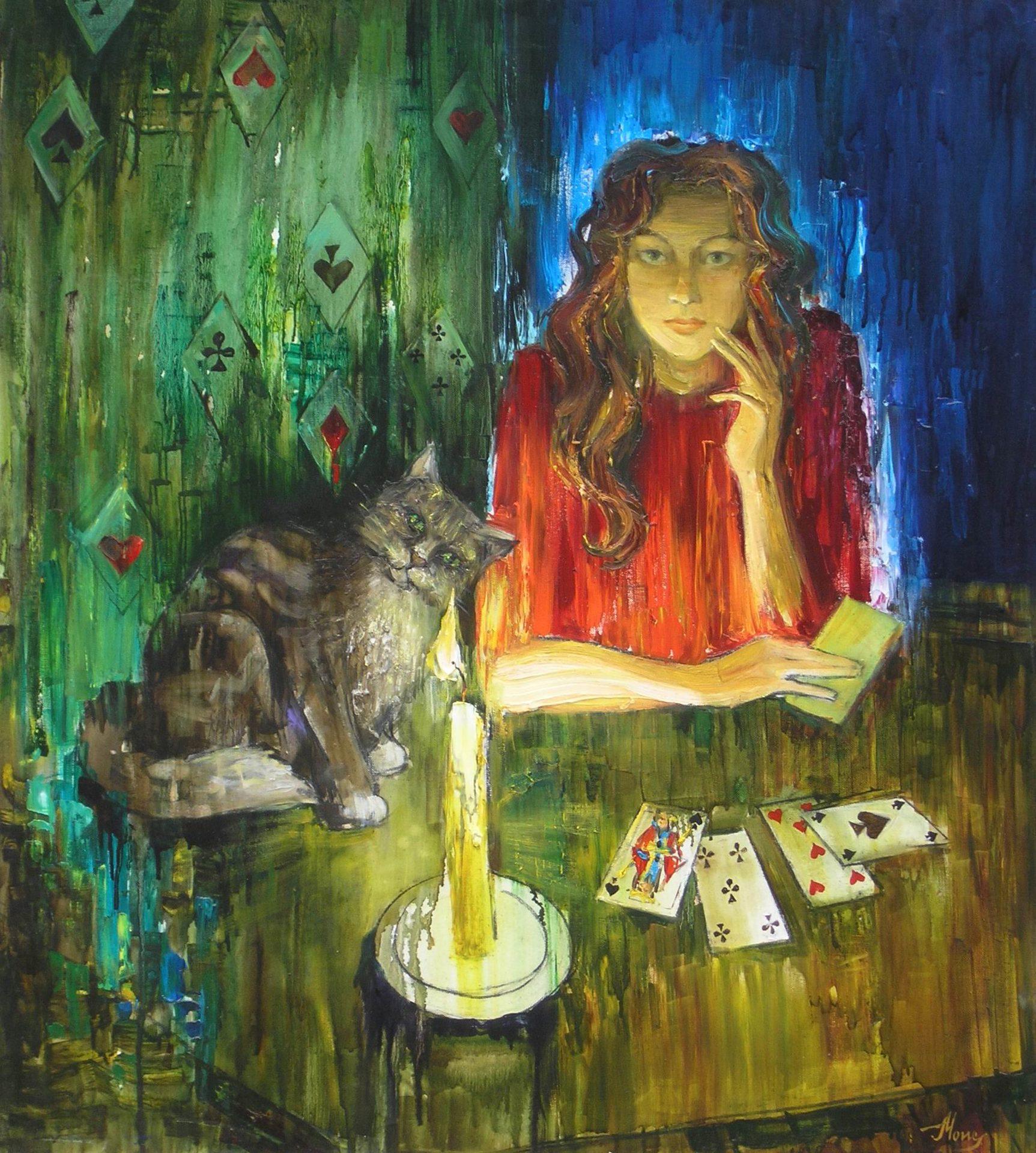
"The Fortune Teller"
oil on canvas on stretcher
95 × 85 cm
2004
This painting is a vivid example of symbolism, in which every detail carries a particular meaning. Let us unpack the artist's intent step by step.
1. Composition and Atmosphere
The painting is divided into two parts: warm (the woman, the table, the candle) and cool (the walls). This creates a contrast between the heroine's inner world and the space outside.
* Shadows: The painting style recalls the work of Marc Chagall or Salvador Dali. Blurred contours and "fluid" shadows create the feeling of a dream or reverie. The heroine seems not merely to sit at the table but to hover above it.
* The candle: The only source of light. It symbolizes truth, knowledge or a person's inner light. Its flame illuminates only what matters to the story, leaving the rest of the room in the gloom of uncertainty.
2. The Symbolism of the Cards
The cards are the central element of the painting. They lie on the table and hang on the wall like wallpaper.
* The four suits: In the classical interpretation they symbolize four elements and spheres of life:
*
Spades: swords, air; intellect, conflict, decisions.
*
Clubs: wands, earth; labor, finances, material goods.
*
Diamonds: coins, gold; wealth, pleasure, risk-taking.
*
Hearts: cups, water; feelings, love, emotions.
* A game with fate: The whole wall to the woman's left is covered with cards. This may mean that life is a game in which we are surrounded by chance and probability. The cards determine our path, but we ourselves choose which card to turn over.
* The hand of fate: There is no deck in the painting from which cards are drawn. The woman holds a single card in her hand, and several more lie before her. This underscores the idea that fate has already been laid out around us, and all that remains is to make a choice.
3. The Image of the Woman
The heroine is the central figure of the composition. Her pose and gaze say a great deal.
* Pensiveness: Resting her head on her hand, she looks straight at the viewer. It is a classic gesture of reflection. The gaze is direct but slightly distant, as if the woman is trying to make out something more than just the card in her hands.
* The red clothing: Red is associated with passion, energy, life and danger. It stands out sharply against the dark walls, making the woman the center of attraction. Perhaps the red here symbolizes the life force that stands against the world's cold indifference.
4. The Cat
The presence of the cat adds mysticism and depth to the painting.
* The observer: The cat sits beside the woman, but its gaze is directed not at her but somewhere into the distance, over the table. It sees more than a person does. In mythology the cat often serves as a guide between worlds or a keeper of secrets.
* A symbol of intuition: If the woman embodies reason and analysis (she studies the card), the cat is intuition and the subconscious. Their sharing a table speaks to the need for balance between logic and feeling when making decisions.
The Overall Intent
The artist explores the theme of choice and predestination. The painting tells of a person standing on the threshold of an important decision. Life is presented as an endless deck of cards that have already been spilled across the table of existence (the images on the walls) and lie before us (on the table).
The idea is this: each of us is both a player and a card in this game. We can see only a small part of the spread (the cards on the table), but the outcome of the game depends on our choice. The candle is our consciousness, which lights up this narrow circle of possibilities. And the cat is the eternal companion, a reminder that there are forces and knowledge beyond human understanding.
This work is about the search for meaning, the attempt to grasp the chaos of life through the structure of a game, and the fragile balance between control and the will of chance.
Not a fortune teller, not a gypsy...
I just feel more sharply...
A brazen impostor,
I don't stand watch at your door...
I stroke your dreams with my palm
and trace them with a pencil,
dark blue, beyond the window,
where night knocks at the house...
Where our shadows wander
after one another, by chance...
I bring you jam
and brew the tea...
My lips smell of apricot,
and strawberry, and rain...
I love to walk through the dew,
if with a rainbow for company...
I love... I have always loved...
Hundreds of winters and hundreds of years...
I forgave you long ago
that you are not here with me...
I hurry to you to drink
from a living spring...
I am not an angel, nor a bird...
I am a sorceress... a little...
Sometimes I feel sorry for myself...
But I whisper: "Don't pity me..."
Not a gypsy, not a fortune teller...
I just feel more sharply...
Lara Mishanova